I’ve skipped the 3rd Play Journal, if you’re confused where that is.
Also, as much as I’ve tried I haven’t been able to upload video files onto WordPress. Therefore, I won’t be able to explicitly show off Journey’s beautiful soundtrack in this blog. I’ll instead be referencing a linked YouTube video by timestamps.
“Where hands, senses, bodies and the tangible
Simon Niedenthal pg. 7
qualities of games meet, the aesthetic meaning of games
emerges.”
Journey is a game which I believe embodies Niedenthal conclusion on aesthetics to the fullest. The controls are simple; the gameplay is easy and fun; the sound design acute; the music is moving; the visual art is beautiful. All these elements feed off and into each other, making the play experience a truly aesthetic one for the player. But what exactly is Journey‘s aesthetic experience?
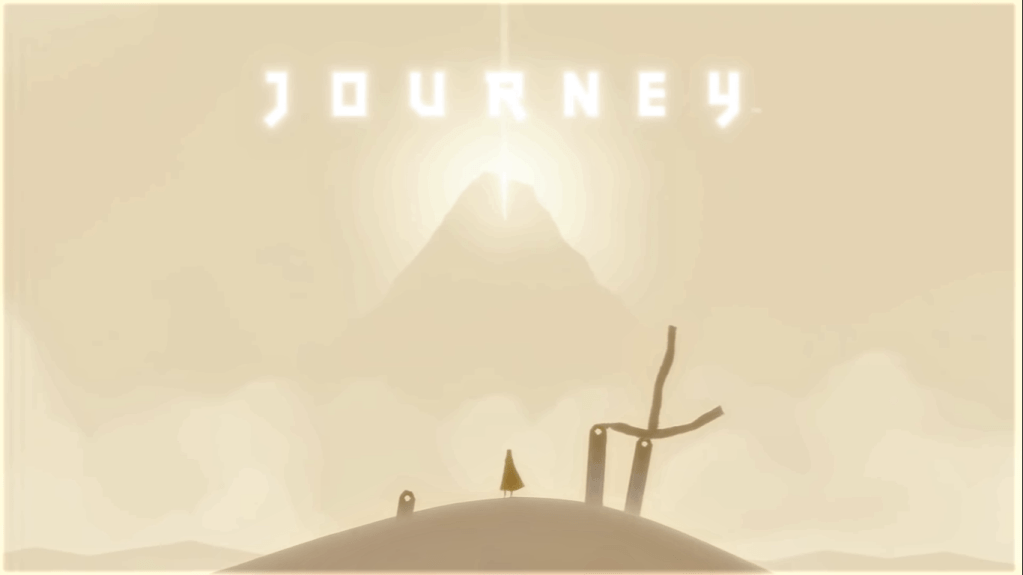
I believe that every good story, regardless of medium, should start off with a beginning like Journey‘s; it highlights what the rest of the game will encompass. It shows that there is a theme of loneliness, with the barren lands and the lone cello. These can be hostile, as seen with some of the dust clouds and the gale-like soundscape. There’s also a specific goal — to reach the mountain-top — echoed in reaching the top of the dune, giving us a theme of perseverance. There’s an elegance and beauty to the game — reinforced by the visuals, music, and simple controls/mechanics — making the game serious, calming, and spiritual. The cohesion between all of the elements in this scene makes one feel as though this “journey” will be an epic one — all the more reinforced with the title reveal (IAmSp00n 2:20).
So the cohesion of its elements makes Journey an aesthetically epic game then? I believe so, but this “epic” aesthetic is not the only emotion that we get from the gameplay. One view of game aesthetics is that it’s “an expression of the game experienced as pleasure, emotion, …etc” (Niedenthal 2). There is an overarching feeling of epicness, but there’s also moments of fun, awe, loneliness, distress, and spirituality. Although the game’s cohesion brings Journey to the realm of the aesthetic, I believe that the music more than anything else elevates it to a colorfully emotional aesthetic.

Collins says that immersion in games is complemented by the aural “communication of emotional meaning” (133). Journey‘s generally “interactive nondiegetic” music allows for this communication (Collins 126).
Music is the voice of the soul; and the player character’s voice is represented by the cello. Seen above is an image from a “transitional” sequence, which starts at 30:20 and ends at 32:37 (IAmSp00n). When you are with the other creatures, a joyful theme plays with flutes and various other instruments. But as you glide along and see the mountain, you also happen to notice buildings of the player character’s long lost culture. Here, even though you are not separated from the other creatures, the cello plays at the forefront, echoing the theme of loneliness — and makes us feel a solitude deeper than we could have thought of.
To conclude, we see that the cohesion of Journey‘s elements led to an aesthetic guided by emotions, these being largely defined by its music. The gameplay experience for each player thus reflects this.
Works Cited:
Collins, Karen. “Chapter 7: Gameplay, Genre, and the Functions of Game Audio.” Game Sound. MIT, 2008.
IAmSp00n. “Journey – Gameplay / Playthrough (No Commentary).” Youtube, 21 March, 2012, https://youtu.be/bkL94nKSd2M.
Journey. Thatgamecompany, 2012. PlayStation 3.
Niedenthal, Simon. “What We Talk About When We Talk About Game Aesthetics.” Malmö University, 2009.
All images were found from online sources:
 Play Journal for RTF 331P Spring 2020